Enjoyed this post?
Be sure to subscribe to the nopAccelerate newsletter and get regular updates about awesome posts just like this one and more!
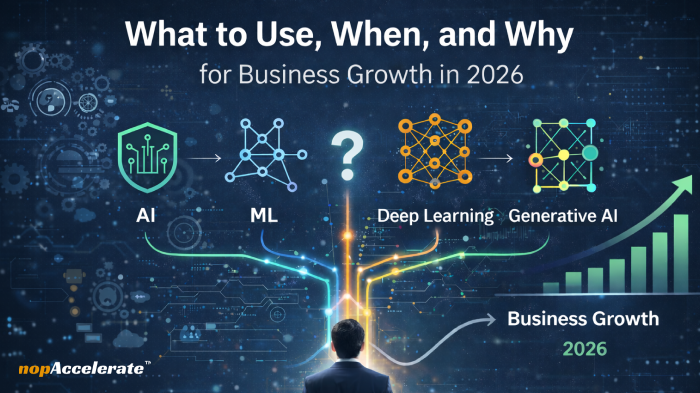







Artificial intelligence has moved beyond experimentation. In 2026, it is actively shaping how businesses operate, compete, and make decisions. In fact, AI is already embedded across industries, with a majority of organizations now using it in some form to improve efficiency, personalization, and decision-making.
Today, nearly 78% of organizations use AI in at least one business function, up significantly from the previous year, confirming that AI adoption has moved firmly into the mainstream.
Yet despite this rapid adoption, many leaders still face a fundamental challenge: understanding which type of AI actually fits their business needs.
This guide focuses on how these technologies are applied in real business environments, when they make sense to adopt, and how they influence growth, efficiency, and customer experience.
The objective is simple: help you evaluate AI choices strategically in 2026, so you can invest with confidence, reduce risk, and focus on outcomes that truly matter.
Artificial intelligence is no longer optional for modern businesses. What has changed in 2026 is not whether companies use AI, but how intentionally they choose and apply it.
Recent industry surveys show that 85% of organizations increased AI investment, and over 90% plan further spending, making AI decisions central to long-term business strategy.
Many organizations still treat AI as a single solution, when in reality it represents a range of technologies designed to solve very different problems. Some businesses gain immediate value from straightforward automation. Others rely on predictive models to improve forecasting or personalization.
Treating these approaches as interchangeable often leads to over-engineering, rising costs, and slower returns.
For decision-makers, the challenge is no longer understanding what AI is, but answering practical questions:
This comparison exists to bring clarity, not complexity.
AI is often discussed as a single capability, but in reality it is a toolbox of different approaches, each built for a specific type of business problem. Some tools automate repeatable decisions, others predict outcomes, and some generate content or insights.
The value of AI does not come from using the most advanced technology, but from choosing the right tool for the outcome you want to achieve.
This perspective helps businesses avoid over-investment and focus on impact.
Before choosing any AI approach, businesses should evaluate intent and readiness. The starting point should always be the business problem, not the technology.
Data maturity, scale, time-to-value, and risk tolerance all play a role. Some AI approaches deliver value quickly with minimal complexity, while others require long-term investment and experimentation. Evaluating AI through these lenses ensures decisions are based on fit and impact, not trends.
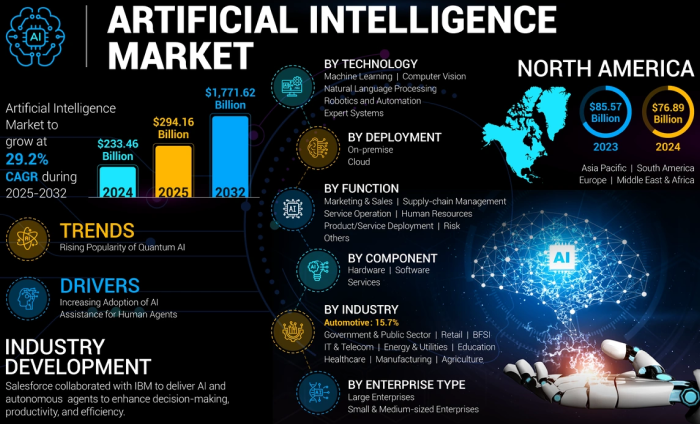
Understanding where each AI approach fits is critical for making practical, cost-effective decisions. These technologies are often discussed together, but from a business standpoint, they solve very different types of problems and require different levels of readiness.
Traditional AI works best when decisions follow clear business rules and results must remain consistent. It helps automate routine workflows where accuracy, control, and predictability matter more than learning or flexibility.
Best suited for:
Machine Learning is useful when businesses want systems to learn from data and improve decisions over time. It supports smarter forecasting, personalization, and optimization as patterns emerge from historical data.
Best suited for:
Deep Learning is designed for complex problems involving large volumes of unstructured data. It makes sense when higher accuracy is critical and the business has the scale, data, and resources to support it.
Best suited for:
Generative AI helps businesses create and respond faster rather than predict outcomes. It is commonly used to support content creation, customer interactions, and internal productivity, with clear guardrails to maintain trust.
Best suited for:
When businesses say they are “using AI,” they usually mean they are using specific AI-powered tools in daily work.
AI creates value only when it solves real business problems.
71% of businesses using AI in marketing and sales report measurable revenue gains, with personalization and automation emerging as the most consistent drivers.
Instead of thinking in terms of technologies, decision-makers should focus on where AI directly improves outcomes across core business functions.
Below are the use cases that consistently deliver impact in 2026.
AI is widely used to improve how customers interact with digital platforms. The focus here is speed, relevance, and personalization across the buyer journey.
Common use cases:
Business impact:
Higher conversions, better engagement, and improved customer satisfaction.
In operations, AI helps businesses move from reactive decisions to proactive planning by identifying patterns in historical and real-time data.
Common use cases:
Business impact:
Reduced costs, fewer stock issues, and better planning accuracy.
AI enables marketing teams to move beyond broad campaigns toward targeted, data-driven experiences that adapt to customer behavior.
Common use cases:
Business impact:
Improved ROI, higher retention, and more efficient spend.
Generative and assistive AI tools are increasingly used to accelerate internal workflows and reduce repetitive work across teams.
Common use cases:
Business impact:
Faster execution, reduced workload, and improved team productivity.
AI supports leadership by turning large volumes of data into actionable insights that improve decision-making speed and confidence.
Common use cases:
Business impact:
Better decisions, lower risk, and stronger strategic planning.
The most successful businesses in 2026 are not using AI everywhere. They are using it where it clearly improves outcomes, supports teams, and aligns with their growth priorities.
If you’re planning AI for your eCommerce business, a focused discussion on use cases, data readiness, and effort can clarify what’s practical before investing.
Request a free expert consultation →
Adopting AI is no longer about being early or late. In 2026, the real question is whether your business is ready for a specific type of AI. Timing depends less on trends and more on clarity around data, scale, and business priorities.
Not every organization needs the same level of intelligence at the same time. Some benefit immediately from simple automation, while others require predictive or generative capabilities to support growth.
For early-stage or smaller teams, the priority is usually efficiency and focus. AI should reduce manual effort and help teams do more with limited resources, without adding complexity.
What works best:
Why:
Fast setup, low risk, and immediate operational gains.
As businesses scale, data volume increases and customer expectations rise. At this stage, AI becomes valuable for improving decisions and personalizing experiences.
What works best:
Why:
Better forecasting, smarter personalization, and improved performance as data grows.
Large organizations operate at scale, with complex data and higher accuracy requirements. Advanced AI becomes relevant when incremental improvements deliver significant business value.
What works best:
Why:
High accuracy, scalability, and competitive differentiation justify the investment.
Teams that rely heavily on content, communication, or internal knowledge benefit from AI that accelerates creation and response.
What works best:
Why:
Faster execution, improved productivity, and reduced repetitive work.
When applied intentionally, AI improves speed, consistency, and decision quality in the short term. Over time, it strengthens forecasting, personalization, and operational efficiency.
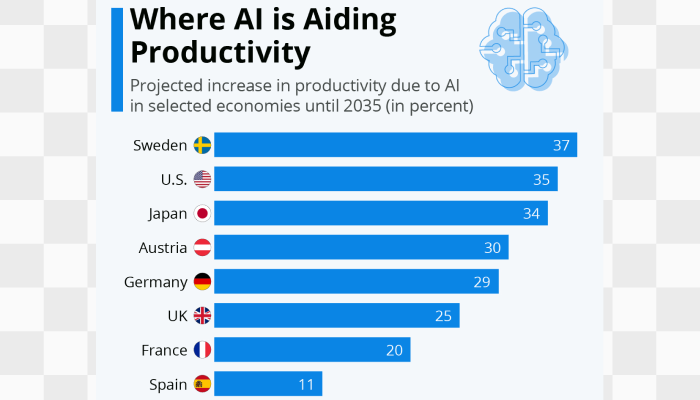
Studies indicate that AI adoption can deliver 26–55% productivity improvements, with businesses seeing an average return of nearly four dollars for every dollar invested.
AI does not replace strategy or expertise. It amplifies them. The strongest results come from clear goals, reliable data, and disciplined execution.
Many AI initiatives fail due to strategic missteps, not technology gaps.
Despite growing investment, research suggests 70–85% of AI initiatives fail to deliver expected business value, most often due to poor alignment, readiness, or execution.
Common mistakes include:
Avoiding these pitfalls keeps AI practical and results-driven.
Choosing how to implement AI is as important as choosing the technology itself.
Many businesses succeed with a hybrid approach that balances control and execution speed.
In 2026, AI success is not about using the most advanced technology. It is about making clear, intentional choices aligned with business goals, data maturity, and operational reality.
AI should simplify decision-making, strengthen operations, and support sustainable growth. When clarity leads, AI becomes a long-term business asset rather than a short-term experiment.
Exploring AI for your eCommerce business growth?
Our eCommerce AI experts review your store, data, and goals to identify where AI can improve search, personalization, operations, and customer experience.









Leave A Comment