Enjoyed this post?
Be sure to subscribe to the nopAccelerate newsletter and get regular updates about awesome posts just like this one and more!







Upgrading a nopCommerce store is not something every business should rush into and doing it at the wrong time can actually create more problems than it solves.
This guide is written for nopCommerce b2b store owners and decision-makers who are unsure whether upgrading is the right move right now, or whether their current setup can still support growth without adding friction.
This guide is for you if:
By the end of this guide, you should be able to answer one simple question with confidence:
Does upgrading my nopCommerce store make sense for my business right now or not?
B2B eCommerce in 2026 no longer operates under “enterprise tolerance.” Buyers now expect the same level of speed, clarity, and self-service they experience in modern SaaS tools and leading digital platforms, even when purchasing complex or high-value orders.
Procurement teams and repeat buyers increasingly expect to:
When these actions require emails, spreadsheets, or manual follow-ups, buyers rarely complain. Instead, decisions slow down, purchases are delayed, or activity shifts offline.
This change means that experience quality now directly affects deal velocity, sales efficiency, and account retention.
In many B2B organizations, the eCommerce platform quietly shapes how effectively the business sells.
Most B2B nopCommerce stores do not fail outright. They continue operating, but with growing friction beneath the surface.
This friction typically appears in three areas.
In many B2B setups:
This increases sales workload, extends RFQ-to-order cycles, and reduces adoption of the digital portal.
B2B stores often manage large catalogs, complex pricing, and frequent repeat purchases.
When performance is not optimized:
In B2B, slow experiences delay decisions and push buyers back to offline channels.
Older B2B implementations often rely on multiple plugins and custom code to support core workflows.
Over time, this leads to:
At this stage, store owners often feel stuck, knowing improvements are needed, but unsure how to move forward safely.
This is usually the point where the question shifts from
“How do we fix this issue?”
to
“Is our current setup still right for where the business is going?”
In B2B eCommerce, losses rarely appear as sudden drops. Instead, small inefficiencies compound over time.
As friction increases, teams invest more effort just to maintain existing performance. Leadership attention shifts from growth initiatives to operational problem-solving.
This is often the moment when store owners realize they are spending more time and money to achieve the same or worse results.
Routine maintenance keeps a store running, but it does not prepare it for modern B2B demands.
Maintenance helps:
However, it does not:
As catalogs, customers, and pricing complexity grow, older architectures become a ceiling rather than a foundation. Changes feel riskier, performance tuning becomes harder, and innovation slows.
At this point, the platform resists progress instead of supporting it.
Before discussing versions, it is important to define what “ready” means for B2B eCommerce today.
A modern B2B nopCommerce store must deliver:
Fast category and search pages, stable performance with large catalogs, and smooth repeat ordering experiences.
Native workflows that reduce manual RFQ handling, simplify quote-to-order conversion, and streamline daily admin tasks.
Search-friendly category and product structures that support research-driven B2B buyers over extended decision journeys.
Built-in support for RFQs, quotes, customer-specific pricing, wishlists, and repeat orders, without relying on fragile workarounds.
Strong security practices, accessibility compliance, and a stable foundation that enterprise buyers trust.
Many older nopCommerce versions were designed when eCommerce played a supporting role in B2B sales.
Common limitations include:
Each year these limitations remain, technical debt grows and future upgrades become more complex.
By this point, most B2B nopCommerce store owners are not asking whether change is needed.
They are asking a more practical question:
What exactly improves if we move to nopCommerce 4.90 and how does that affect our B2B operations?
| B2B Area | Older nopCommerce | nopCommerce 4.90 |
| Platform Foundation | Older .NET runtime, limited future readiness | Built on .NET 9, enterprise-ready and future-proof |
| Performance & Scalability | Slower category/search pages as catalogs grow | Major performance optimizations for large catalogs |
| RFQ & Quote Workflows | Plugin-based or email-driven RFQs | Native RFQ → Quote → Order workflows |
| Pricing & Customer Rules | Basic role-based pricing | Customer-specific, tiered, and negotiated pricing |
| Automation & AI Readiness | Manual content, SEO, translations | AI-driven product content, SEO & translations |
| Buyer Self-Service | Limited repeat ordering | Multiple wishlists, faster reorders, account tools |
| Admin Productivity | Time-consuming daily operations | Streamlined admin UX & bulk actions |
| Security & Compliance | Reactive updates | Enterprise security + accessibility compliance |
| Long-Term Maintenance Risk | Growing technical debt | Lower maintenance risk, upgrade-ready foundation |
Native RFQ workflows combined with AI-driven automation represent a major shift for B2B commerce. Instead of fragmented processes, buying becomes structured, faster, and easier to manage.
Performance improvements are especially impactful for B2B environments where scale is the norm. Faster experiences increase buyer confidence and portal adoption.
Most importantly, nopCommerce 4.90 reduces long-term risk by providing a cleaner, future-ready foundation.
While every store is different, B2B organizations that modernize their nopCommerce platform commonly see:
In practice, this means the eCommerce platform evolves from a support tool into a scalable sales engine.
B2B nopCommerce upgrades are often delayed due to concerns around cost, complexity, and protecting existing workflows. This hesitation usually comes from avoiding disruption, not from ignoring growth.
However, delaying too long can limit productivity and future opportunities. At this stage, working with an experienced nopCommerce development team allows businesses to upgrade confidently, ensuring a smooth transition that protects data, preserves workflows, and avoids downtime.
B2B eCommerce is accelerating rapidly, projected to reach $36.86 trillion in 2026, up from $32.11 trillion in 2025. Digital-first strategies already deliver 15% higher B2B sales performance, while automation is expected to save over $1.5 trillion globally. With 88% of B2B buyers using marketplaces annually, expectations around speed, automation, and self-service are now standard.
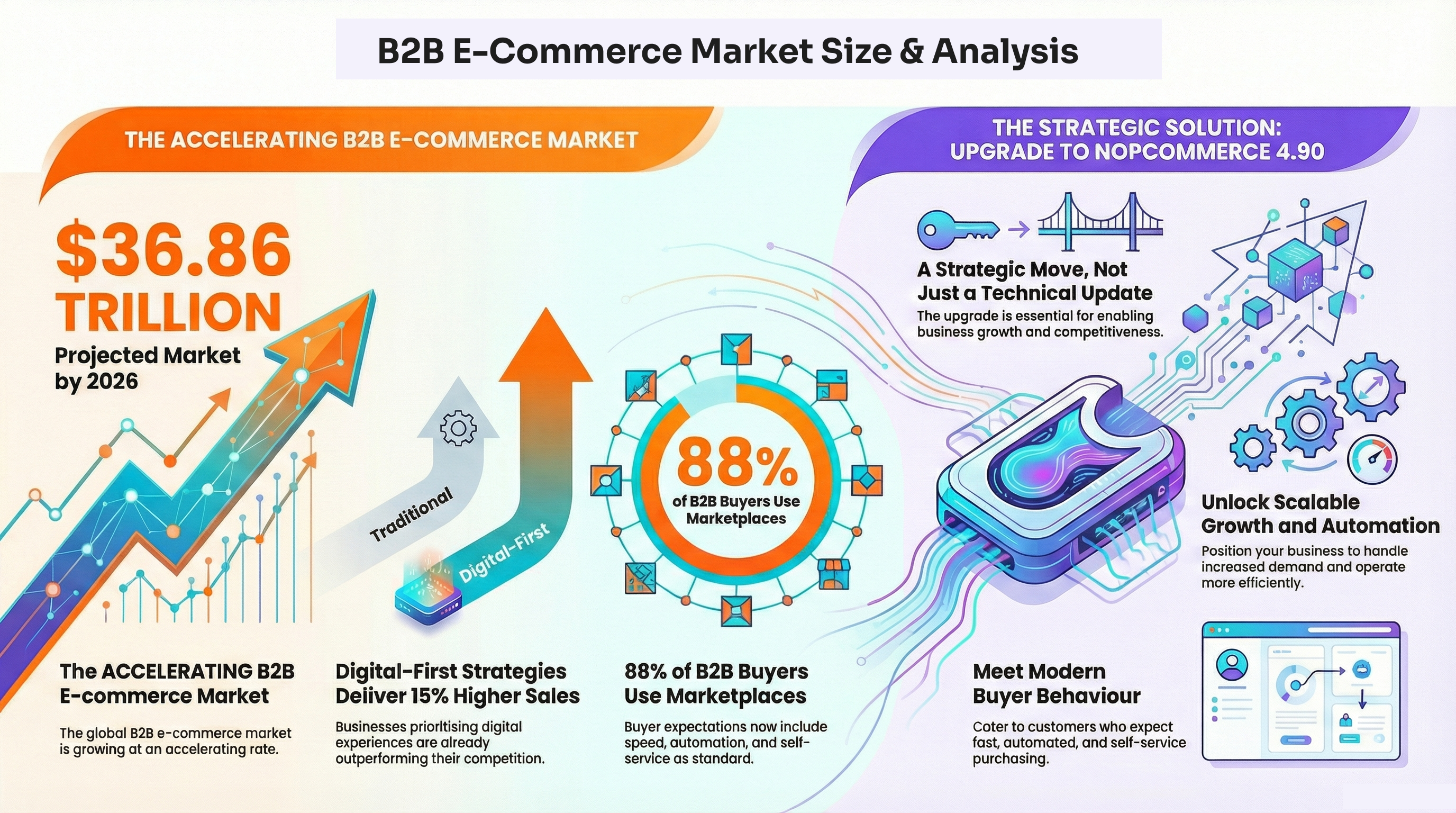
For nopCommerce B2B store owners, upgrading to nopCommerce 4.90 is no longer just technical, it’s a strategic move to enable scalable growth, automation, and modern buying behavior.
In 2026, B2B growth depends on more than keeping your store running. If manual workflows, performance limits, or scalability issues slow progress, upgrading to a modern nopCommerce foundation becomes a strategic decision, one that improves efficiency, buyer experience, and long-term competitiveness.
Partner with nopAccelerate, your trusted nopCommerce experts, to upgrade smoothly to 4.90 without downtime, data loss, or disruption, at a competitive cost with reliable post-upgrade support.









Leave A Comment