Enjoyed this post?
Be sure to subscribe to the nopAccelerate newsletter and get regular updates about awesome posts just like this one and more!
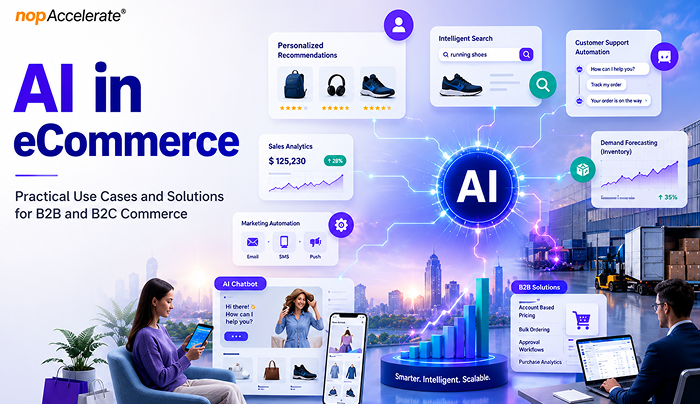







Artificial intelligence has quickly moved from a competitive advantage to a business necessity in eCommerce.
Retailers face rising customer acquisition costs, growing customer expectations, and increasing operational complexity. Meanwhile, shoppers expect fast product discovery, personalized experiences, accurate inventory visibility, seamless support, and frictionless checkout across every channel. Businesses that fail to meet these expectations risk losing customers to competitors that can.
This is where AI is creating measurable value. From product recommendations and search optimization to demand forecasting and fraud prevention, AI helps businesses improve customer experiences while increasing operational efficiency.
According to McKinsey, AI-powered personalization can help leading organizations generate up to 40% more revenue from those activities than slower-moving competitors. Yet many businesses struggle because they focus on AI tools before identifying clear objectives and high-impact use cases.
This guide explores where AI delivers the greatest value across the eCommerce journey and how businesses can adopt it strategically.
When people hear AI, they often think of chatbots or content creation tools. In reality, AI supports many more eCommerce activities.
At its core, AI helps businesses analyze large amounts of data, spot patterns, make predictions, and automate tasks that would otherwise take significant time and effort.
Several technologies make this possible:
AI adoption continues to grow because businesses now collect more customer, product, and business data than ever before. AI helps turn that data into actions that improve efficiency, customer experience, and revenue.
Rather than replacing people, AI helps teams save time, reduce manual work, uncover useful insights, and make better decisions.
Personalization is one of the most valuable uses of AI in eCommerce industry.
Customers no longer respond well to generic shopping experiences. They expect brands to understand their preferences, buying behavior, and interests. AI makes this possible by analyzing browsing activity, purchase history, and customer behavior.
For example, a customer who regularly buys fitness products may see different recommendations and promotions than someone shopping for home décor. The goal is to help customers find relevant products faster.
Common personalization use cases include:
Personalization does more than improve conversion rates. It can increase average order value, improve customer retention, and strengthen customer relationships.
Product discovery has become one of the most important areas in eCommerce.
Customers often know what problem they want to solve but struggle to describe it using product-specific terms. Traditional keyword search can fail because it matches words rather than understanding intent.
For example, a customer searching for “comfortable shoes for standing all day” is looking for a solution, not a category page.
AI-powered search helps bridge that gap by understanding context, customer behavior, and search intent.
Applications include:
Poor search experiences often lead to higher bounce rates and abandoned shopping sessions. Better search helps customers find the right products faster, reducing friction throughout the buying journey.
Customer support is often one of the first areas where retailers invest in AI because it improves both customer experience and operational efficiency.
Support teams spend a large amount of time answering repetitive questions about orders, deliveries, returns, refunds, product availability, and account information. While important, many of these interactions follow predictable patterns.
AI can automate routine support tasks, allowing human agents to focus on situations that require empathy, judgment, or complex problem-solving.
Common applications include:
The benefits go beyond cost savings. Faster responses improve customer satisfaction and reduce frustration throughout the customer journey.
Many retailers are also adopting customer service automation to deliver faster and more consistent support experiences. Customers can quickly access answers to common product, order, and policy questions without waiting for assistance.
This helps businesses create more responsive support operations while reducing pressure on internal teams.
Inventory management remains one of the biggest challenges in eCommerce.
Stock too much inventory and cash gets tied up in unsold products. Stock too little and businesses risk lost sales, unhappy customers, and damaged trust. AI helps reduce this uncertainty.
By analyzing sales patterns, seasonal trends, inventory levels, supplier performance, and market signals, AI can improve forecasting accuracy and support better planning.
Common operational applications include:
Research from McKinsey has found that organizations using AI in supply chain operations have reported improvements in logistics efficiency, inventory management, and service performance.
For retailers, these improvements can lead to lower operating costs, fewer stockouts, and better customer experiences.
Pricing decisions have always required balancing profitability and competitiveness.
The challenge is that market conditions constantly change. Competitor pricing, inventory levels, customer demand, and promotions can all influence pricing decisions. AI helps businesses respond faster.
Instead of relying entirely on manual analysis, pricing engines can continuously evaluate market conditions and recommend pricing changes based on business goals.
Common revenue optimization applications include:
AI is also becoming increasingly important for fraud prevention.
As online transactions grow, so do fraud risks. Traditional rule-based systems often struggle to keep up with more sophisticated threats.
AI helps identify suspicious activity by analyzing transaction patterns, customer behavior, device activity, and account history in real time.
Key security applications include:
The result is stronger security without adding unnecessary friction for legitimate customers.
Content has become a major challenge for growing eCommerce businesses.
Every new product requires descriptions, metadata, category content, promotional messaging, emails, social media assets, and ad copy. As product catalogs grow, managing content at scale becomes increasingly difficult.
AI helps retailers create and optimize content faster while maintaining consistency across channels.
Common applications include:
The biggest value is not replacing content teams but helping them work more efficiently. For example, retailers can use AI to generate initial product content while teams focus on quality control and brand alignment.
Another emerging area is agentic commerce.
Unlike traditional AI systems that wait for instructions, AI agents can work toward defined goals by analyzing information, making recommendations, and completing tasks with limited human input.
Potential applications include:
While still in the early stages, agentic AI is expected to play a larger role in commerce operations in the years ahead.
Although the underlying technology may be similar, B2B and B2C organizations often use AI to solve different business challenges.
The difference lies in buying behavior, decision-making processes, and business objectives.
| Area | B2B eCommerce | B2C eCommerce |
| Buying Journey | Longer and multi-step | Faster and more transactional |
| Decision Makers | Multiple stakeholders | Individual shoppers |
| Personalization | Account-based | Individual-based |
| Average Order Value | Higher | Lower |
| Primary Objective | Efficiency and account growth | Conversion and customer experience |
| Key AI Focus | Automation and forecasting | Personalization and engagement |
B2B commerce involves longer sales cycles, multiple stakeholders, and complex purchasing processes. AI helps improve efficiency through lead qualification, procurement forecasting, order automation, pricing optimization, and workflow support.
B2C retailers use AI to enhance customer experiences through personalization, product recommendations, visual search, dynamic pricing, cart recovery, and customer service automation that improves engagement and conversions.
Not every AI solution delivers the same value. The best approach is to prioritize solutions that align with your customers, business goals, and operational challenges.
B2B organizations typically benefit from AI solutions that simplify complex purchasing processes and improve efficiency.
Priority solutions:
These solutions help streamline operations, improve buyer experiences, and support account growth.
B2C retailers often achieve the strongest results from AI solutions that improve product discovery, engagement, and conversions.
Priority solutions:
These capabilities help customers find products faster and create more relevant shopping experiences.
AI is creating value across both B2B and B2C eCommerce, but success depends on applying the right solutions to the right business challenges. Organizations that focus on practical use cases, measurable outcomes, and customer needs are more likely to improve efficiency, enhance experiences, and achieve sustainable growth with AI.









Leave A Comment