How to Use Claude AI with Selenium (Python) for Smarter UI Testing
Modern QA and development teams are constantly seeking faster, smarter ways to test web applications. By combining Claude AI, a conversational coding assistant by Anthropic, with Selenium (WebDriver for Python), you can automate UI test creation, execution, and refactoring with minimal manual effort.
In this guide, you’ll learn how to set up Claude AI in Visual Studio Code, generate a working Selenium login test in Python, and apply reusable prompt recipes to accelerate your automation workflow.
This hands-on approach helps you:
- Eliminate repetitive test scripting
- Improve code reliability and readability
- Shorten regression cycles using AI-assisted generation
Whether you’re a QA engineer, developer, or automation lead, this guide shows how to turn Claude AI into a practical co-pilot for your Selenium test framework.
TL;DR:
This guide walks you through setting up Claude AI in VS Code and pairing it with Selenium (Python) for AI-assisted UI automation. You’ll install dependencies, create your first login test using Claude prompts, and learn reusable patterns to speed up test case generation and maintenance.
Setting Up Your AI-Powered UI Testing Environment
To start building our AI-assisted UI automation setup, we’ll use Python with Selenium, supported by Claude AI inside Visual Studio Code. This stack helps automate common web UI flows like login, signup, and checkout quickly and reliably.
Tools You’ll Use
| Tool | Purpose |
| Claude Code (Anthropic) | AI assistant accessible via CLI or VS Code extension; can scaffold tests, explain errors, and refactor code. |
| Selenium WebDriver (Python) | Industry-standard library for browser automation and UI test execution. |
| Python 3.10 + | Scripting language; tested with Python 3.10 and newer versions. |
| Visual Studio Code | Lightweight IDE with integrated terminal and extensions for AI coding. |
| Webdriver-manager | Automatically downloads and keeps browser drivers updated, no manual setup needed. |
Tip: Make sure you’re logged in to Claude AI before running any terminal commands.
Step-by-Step Installation
Follow these steps to get your environment ready:
1. Install Python and VS Code
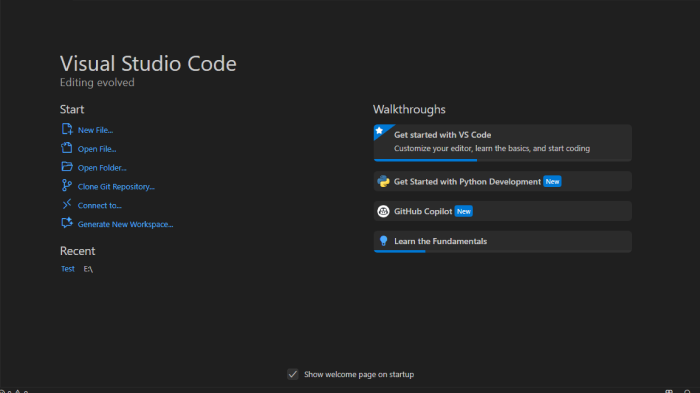
Welcome screen of Visual Studio Code after installation.
- Download and install Python 3.10 or higher.
- Install Visual Studio Code.
2. Install Claude AI Extension in VS Code
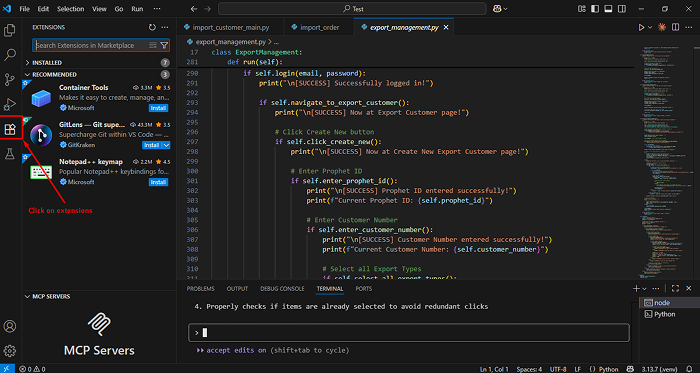
Navigate to Extensions in VS Code to install Claude AI.
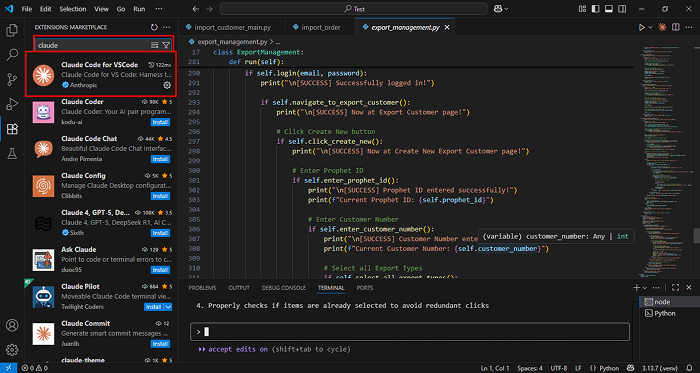
Search and install the Claude AI extension from VS Code Marketplace.
- Open VS Code → Extensions pane → search for “Claude AI”.
- Click Install, then Sign In to Anthropic Account when prompted.
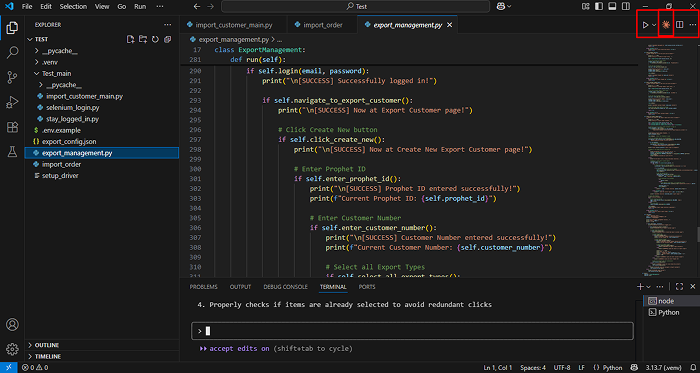
Use the top-right menu to open a new integrated terminal.
3. Verify Claude CLI Access
Claude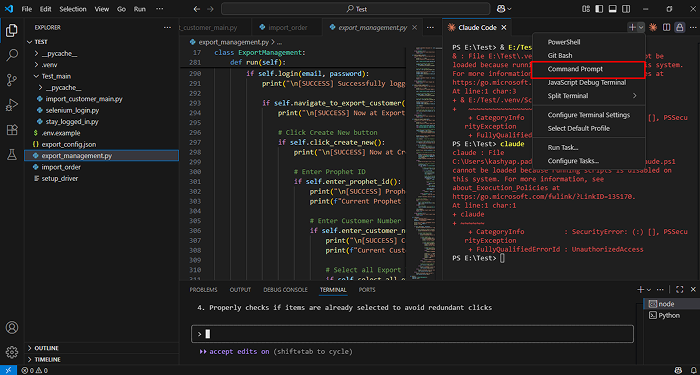
Select Command Prompt in VS Code terminal before running Claude CLI.
You should see a command-line prompt ready to accept AI instructions.
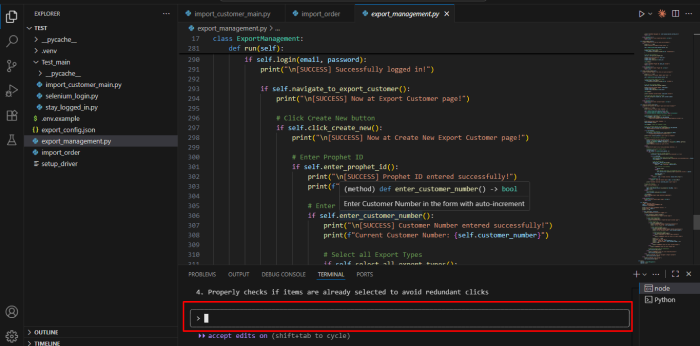
Enter your natural-language prompt here for Claude to generate code.
4. Set Up Your Python Environment
pip install selenium webdriver-managerThese packages install Selenium WebDriver and webdriver-manager.
5. Create a New Project Folder
mkdir ai_ui_tests && cd ai_ui_tests
 code
Start a Fresh Script (with AI Help)
With Claude configured, you can now scaffold a new test script directly from the terminal or VS Code chat.
In the terminal, type:
claudeWhen prompted, enter something like:
Create a Python Selenium test that opens https://example.com/login, enters email and password, and verifies the dashboard loads.Claude will instantly generate the boilerplate test, import statements, and setup/teardown functions.
Why it works:
Claude AI interprets your intent and converts it into executable code, saving you the effort of writing repetitive boilerplate.
Tip: Provide context such as element locators, expected outcomes, and environment details so Claude produces accurate selectors.
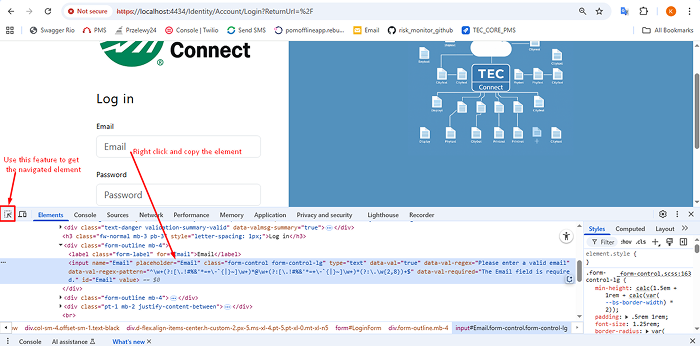
Inspecting the Email field in Chrome DevTools to copy its locator.
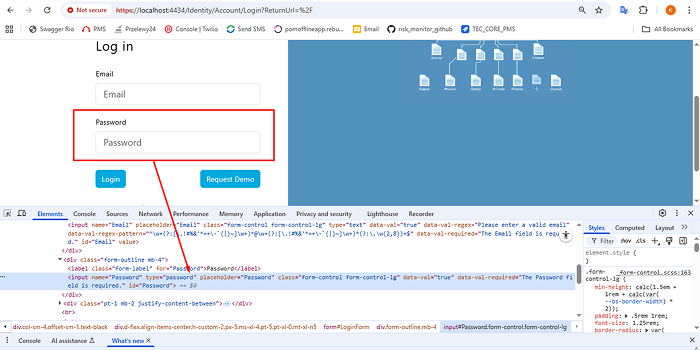
Inspecting the Password field in Chrome DevTools for locator path.
Example: Login Test (Page Object Model)
Claude can create structured code following the Page Object Model (POM) pattern for maintainable tests.
Here’s an example output you might receive:
from selenium import webdriver
from selenium.webdriver.common.by import By
from webdriver_manager.chrome import ChromeDriverManager

class LoginPage:
    def __init__(self, driver):
        self.driver = driver
        self.email_input = (By.ID, "Email")
        self.password_input = (By.ID, "Password")
        self.login_btn = (By.CSS_SELECTOR, "button[type='submit']")

    def login(self, email, password):
        self.driver.find_element(*self.email_input).send_keys(email)
        self.driver.find_element(*self.password_input).send_keys(password)
        self.driver.find_element(*self.login_btn).click()

def test_login():
    driver = webdriver.Chrome(ChromeDriverManager().install())
    driver.get("https://example.com/login")
    login_page = LoginPage(driver)
    login_page.login("[email protected]", "secure123")
    assert "Dashboard" in driver.title
    driver.quit()
Claude Prompt Example:
Write a Python Selenium login test using Page Object Model for example.com and verify dashboard title.This modular approach separates page elements from logic, making your tests easier to maintain.
Prompt Recipes You Can Reuse
| Goal | Sample Prompt |
| Refactor an existing test | “Refactor my Python Selenium login test to use Page Object Model and add wait conditions.” |
| Generate edge-case tests | “Create negative test cases for invalid login inputs and assert error messages.” |
| Explain errors | “Explain the Selenium NoSuchElementException in this stack trace and suggest a fix.” |
| Optimize selectors | “Replace XPath locators with stable CSS selectors for better test reliability.” |
| Integrate with CI/CD | “Show how to run these tests in GitHub Actions with pytest.” |
Tip: You can chain prompts like:
“Generate login test → Add assertions → Refactor to POM → Integrate with pytest.”
Conclusion
AI is steadily transforming how modern teams approach testing.
By combining Claude AI’s natural-language code generation with the reliability of Selenium (WebDriver for Python), you can eliminate hours of repetitive scripting, improve coverage consistency, and release faster with fewer regressions.
This workflow doesn’t replace human testers, it augments them. Claude takes care of scaffolding, refactoring, and documenting test logic, so engineers can focus on creative problem-solving, edge-case design, and performance validation.
As AI-assisted development matures, tools like Claude, Selenium, and VS Code will become the backbone of agile, quality-driven software delivery.
Next Steps
Try out the prompt recipes in this guide and adapt them to your project’s login, checkout, or dashboard flows.
Integrate Claude-generated tests into your CI/CD pipeline using pytest or GitHub Actions.
Keep exploring AI-powered testing techniques to improve reliability and speed in your releases.
If you or your team are exploring how to integrate AI into development or testing workflows, contact our engineers at nopAccelerate , we would be glad to share practical insights or collaborate on your next automation challenge.